Showing posts with label Science. Show all posts

Monday, August 26, 2013

Save Fred!

We are preparing to begin our first science unit of the year. Before we begin our unit we must first learn the scientific method and know exactly how to set up our science notebooks. 

Friday we took some time to learn about the scientific method. 
We began by creating a flip book with each of the components we will be using in our notebook entries. 

Then, we conducted our first investigation, Save Fred. 
Fred is a worm whose boat capsized. Fred does not know how to swim and his life preserver is stuck under the boat. 
The students had to save Fred (a gummy worm) by using only 4 paper clips. They could not touch Fred with their hands, and if Fred fell overboard 3 times then he was dead :(. 
To save Fred students had to retrieve his life preserver from underneath the boat and put it around him. 
They had a BLAST with this activity!


Friday, February 15, 2013

A battery, bulb, and wire

Our electricity unit began this week!  On the first day of our investigation study students were given 1 d-cell battery, 1 light bulb, and 1 wire.  They were asked to use these materials to make their light bulb light.  After a few frustrations everyone in the class was finally successful!
They learned their wire must make a positive and negative connection, and the metal tip of their light bulb must come in contact with the wire or a poll of the battery. 


Solar System Scavenger Hunt

We studied space during the month of January.  We studied the planets, our galaxy, and other items in our solar system, but our main focus was on space technology and its change throughout the years.  As we wrapped our study of space up they students took a scavenger hunt around the school to answer various questions about space.  They had a great time doing this.

Baby Chicks

Before Christmas break Mrs. White had 7 chicken eggs in an incubator in her classroom.  We were able to watch the eggs hatch and see the baby chicks pop their heads out.  It was the most precious thing and the kids LOVED it!


Tuesday, December 11, 2012

Fiddler Crabs

Tuesday we went back to the Adventure Lab to meet our Fiddler Crabs.  Each student received their own crab to observe.  

They noticed that the crab's carapace was typically a dark brown.

 They saw little feeler hairs on the crab's legs.

They learned that the crabs can only move from side-to-side.

A few other things they learned were:
Fiddler Crabs molt by their exoskeleton softening enough to grow
Fiddler Crabs have gills to help them breathe under water
Male Fiddler Crabs have one large chelae and one small chelae
Female Fiddler Crabs have two small chelae
They have two eye stalks on their cephalathorax

Dwarf African Frogs

Monday we traveled to the Adventure Lab to FINALLY meet our critters.  The first animal we had to pleasure of observing was the Dwarf African Frog.  The students were able to see just how tiny these little creatures are.  They were fascinated!

They learned that the frog's webbed feet help it as it swims.
 

The were able to see just how thin the frog's skin is.

They learned that the frogs molt, or shed their skin.

 They also saw their tiny little claws.

We had a great time observing our frogs!

Wednesday, November 7, 2012

Animal Olympics

Unfortunately I do not have any pictures from the completion of the Animal Olympics.  I was so engaged in the experience that I forgot to snap a few pictures!

Today the students competed in a long jump and a high jump.  Mrs. Sain was responsible for the long jump so I do not know the longest jump, but I do encourage you to ask your child how far they jumped and how that compares to a kangaroo.  I was in charge of the high jump.  The highest jump recorded was 84 in. or 7 ft.  The students know that a flea can jump 130 times its height.  They realized they couldn't even jump twice their height.

We discussed the animals' adaptations and how they are helpful to their survival.  It was a lot of fun!

Tuesday, November 6, 2012

Animal Olympics

This week the students began working on an animal adaptations project.  They are learning about features animals have that help them survive.

Today we went outside for a 100 yd. sprint.  The students lined up to see how quickly they could run 100 yds.  I believe our fastest time was 34 sec.
They compared that to the fact that a Cheetah can run 1 mile in 1 minute.  WOW!

 Following our run we went inside to practice our accuracy and jumping skills.  The students were to jump on an 8x8 in. square without losing their balance, then they were to move to a 4x4 in. square, and finally a 1x1 in. square.  When the square got smaller the challenge became more difficult!
This challenge helped us understand about an antelope's adaptations that help it jump from rock to rock.

Our final test was the wing test.  Each student did as many arm circles as they could in 1 minutes.  The majority of students found they couldn't even make it to 100 arm circles.
Do you know that a hummingbird flaps its wings over 4,000 times a minute?  WOW!!!!

We've had a lot of fun doing this and learning at the same time.  Tomorrow we will practice our jumping skills to compare ourselves to a kangaroo and a flea!

Wednesday, September 12, 2012

Xylophones, Kalimbas, & String Beams, OH MY!

We have LOVED our unit on sound.  The kids have played and played and played.  Yesterday we learned about how length affects the pitch of an instrument/sound source.
We played with several instruments and arranged them from highest pitch to lowest pitch.

We played with a xylophone,

a waterphone,

 a kalimba,


  and a string beam.


We also recorded all of our results in our science notebook as we always do.  

Once we finished working in our science notebook we took some time to make predictions about instruments and their pitch based on their size.  We listened to the flute, clarinet, bassoon, tuba, trumbone, bass drum, and snare drum.  

Ask your child what they learned about length and pitch!


Wednesday, September 5, 2012

Pitches and Data

Today in science we learned how vibrations and length effect pitches.  The students used a tongue depressor to investigate how different lengths create different pitches. 
By the end of the experiment students knew that longer lengths created lower pitches and shorter lengths created higher pitches.  They also learned that slow vibrations create low pitches where fast vibrations create high pitches. 

Our daily data for this week is I'm an Alabama Fan.  I'm an Auburn fan.  Each student placed their magnet where it belonged this morning and following art and library we made a few observations about our data.
We observed that 9 more people like Alabama than Auburn, 5 people like Auburn, 1 person likes Auburn and Alabama, and 1 person doesn't like either Auburn or Alabama.
We then took some time to learn a new piece to our daily data routine, probability.  We created several probability statements about our data using terms like likely, unlikely, certain, impossible, less than, greater than, and equal to.

We also took another multiplication test today.  We were able to welcome NyKia to the "Smarty Pants Club" following today's test.  Way to go, NyKia!


Tuesday, September 4, 2012

Good Vibrations

Today we learned that all sound comes from a vibration.  We began by placing our fingers on our neck and feeling our neck vibrate as we spoke.  We then went through several rotations to learn more about sound and vibrations.

The first rotation was the tone generator.  The kids loved playing with this item because they could adjust the volume and the pitch and make the beans dance on the speaker.  They learned that the beans danced due to the vibrations from the speaker.

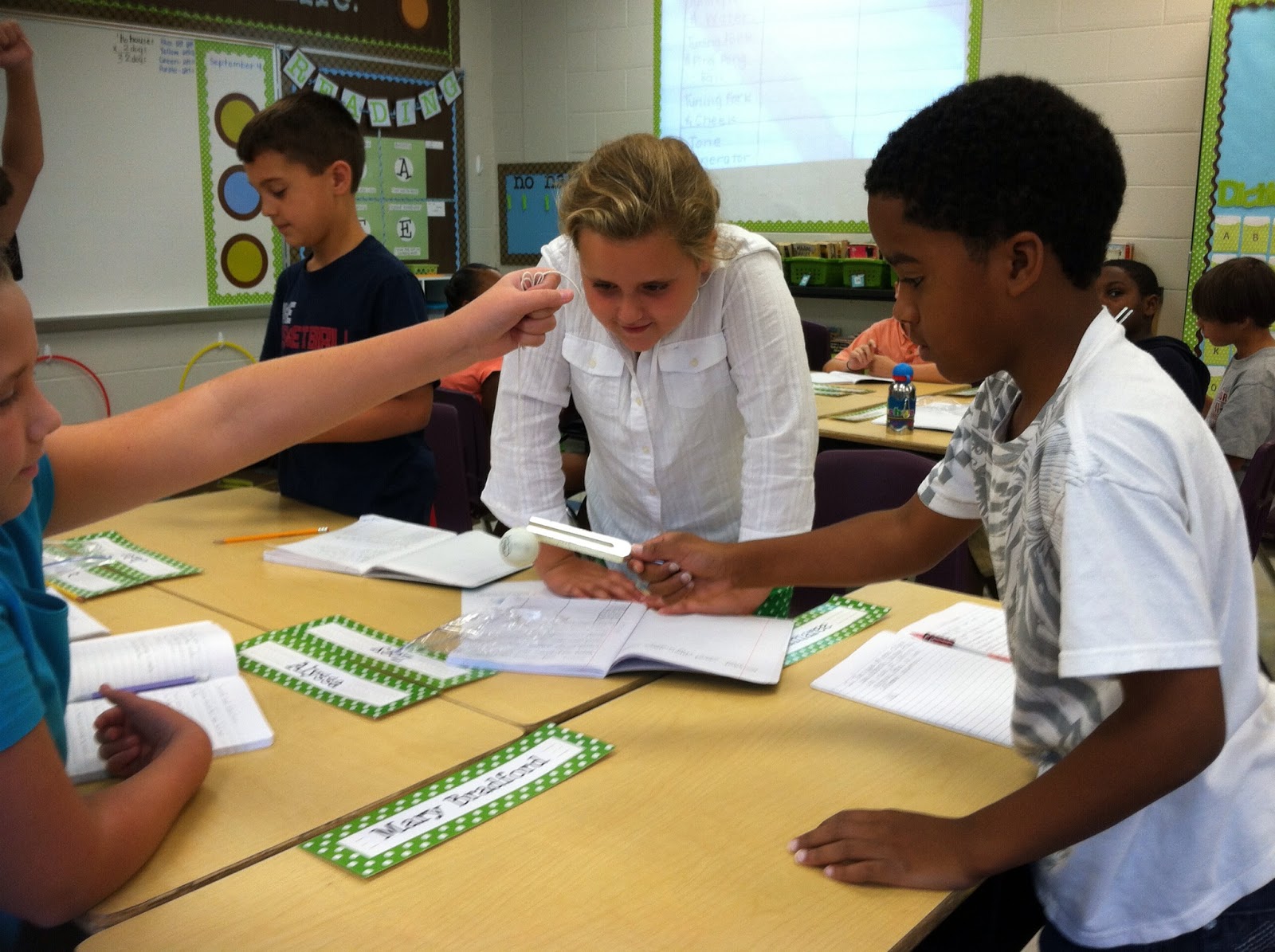
The next rotation was a ping-pong ball and tuning fork.  The students struck the tuning fork on their desk and then placed it against the ping pong ball.  The ping pong ball bounced off of the tuning fork due to the vibrations the tuning fork produced.

At the third station students were asked to strike the tuning fork and place it against their cheek.  This experiment tickles!


The last stop was the tuning fork and water station.  Students struck the tuning fork on their desk and then placed it into a cup of water.  They observed ripples, fizz, and even splashes of water from the vibrations.


Tuesday, August 28, 2012

Lots Of Classwork

 We have been super busy in the classroom this week.  On both Monday and Tuesday the only breaks we have taken were PE and recess.  We have worked our little fingers to the bone!

Each student received their Alabama History book this week.  We have begun talking about government to prepare for our upcoming trip to our state capital.  We looked at pictures of our state capital and the Alabama State House.  Ask your child if they remember the 3 branches of government we briefly discussed today.  If they remember all 3 of them then they deserve ice cream after dinner!

 In math today we took a VERY long assessment.  It was 50 HARD questions.  The new math curriculum we have adopted is very different from what we are used to.  It uses a very different vocabulary so the transition has been pretty difficult for the children.  
I will begin sending math homework home once I am comfortable with their knowledge of the material.  Right now I feel math homework would add unnecessary stress to your home due to the confusing terminology.  Bare with me and hopefully it will begin coming home next week.

We began our Physics of Sound unit in science!  Yesterday we discussed properties of sound and today we used our knowledge of sound properties to help us identify the sounds of various objects in our "Bag-O-Stuff."

BE PROACTIVE!  We used the book Bringing The Rain To Kapiti Plain to learn about being proactive.  Ki-Pat took control of the drought on the plains instead of placing blame on others.  Ki-Pat was able to use the resources that came to him to bring rain to the plain.  Along with learning how to be proactive, we also used this book to learn how to be VORACIOUS READERS, and also a little about rhyming.  
Ask your child what it means to be a voracious reader.  You may also want to ask them if they are a voracious reader.